


Athletic
Supportive Shoes for Flat Feet: Arch Support & Overpronation Control
What Are Flat Feet?
Flat feet (also called fallen arches) means the arch along the inside of the foot sits low or flattens out fully when standing. According to healthdirect, flat feet are often just a normal foot shape — most babies and young children have them naturally, and many adults have them due to family history, tight tendons, or other factors. Healthdirect is clear that "if you have flat feet that aren't causing pain or problems, you don't need treatment" — though flat feet can sometimes lead to pain, stiffness, swelling, or uneven shoe wear.1
Quick self-check: one simple way people check their arch type
Wet the sole of your foot and step onto a dry surface that will show a footprint (a piece of cardboard or a dark tile). A very full footprint with little to no curve on the inside edge suggests a flatter arch. This isn't a diagnosis — if you have pain, stiffness or uneven wear on your shoes, it's worth getting your feet properly assessed at a fitting or by your GP or podiatrist.
Why Does Footwear Matter for Flat Feet?
Healthdirect's footwear guidance is specific: make sure shoes "match the natural shape of your feet," leave room between your longest toe and the end of the shoe, choose "shoes with no heel or a low heel," and pick footwear suited to your activity. It adds plainly that "wearing supportive shoes can help reduce pain and tiredness."1
With a flatter arch, the foot tends to roll inward more than it should when you walk (overpronation). A shoe with a firm heel counter and a medial (inner-side) stabilizer resists that inward roll, while built-in arch support gives the foot something to rest on instead of collapsing fully with every step.
What Should You Look for in Shoes for Flat Feet?
Tap each one to see why it matters:
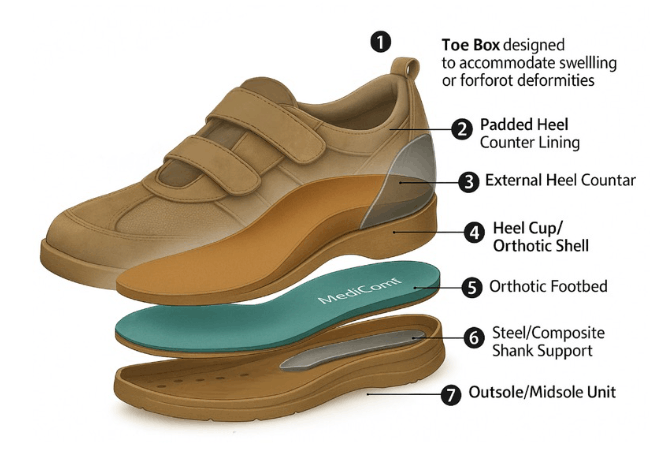
Firm Heel Counter & Medial Stabilizer
Cradles the heel and resists the foot rolling inward, which is the main biomechanical issue with flat feet.
Structured Arch Support
A footbed built with real arch contact gives a flat or low arch something to rest on, instead of collapsing further with each step.
Supportive Shank
A firm shank underfoot (steel, TPU or dual-shank systems) limits how much the midfoot can twist and flatten under load.
Low or No Heel
Per healthdirect's advice, a low or flat heel keeps weight distributed naturally rather than pushing extra load forward onto an already strained arch.
Removable Footbed
Lets you fit a prescribed orthotic or arch-support insole if your own arch needs more correction than the shoe alone provides.
Can Orthotics Help with Flat Feet Too?
The right shoe is a great start, but it doesn't have to be the only tool. Targeted exercises with a physiotherapist can help strengthen the tendons and muscles that support your arch over time, building the kind of support that comes from within the foot itself.
Orthotics work a different way: they provide external support right away, cushioning and correcting your arch position from your very next step. The two approaches complement each other well — strengthening for the long term, orthotics for support in the meantime.
If you haven't tried one yet, an off-the-shelf orthotic is a low-commitment way to see whether extra arch support makes a difference for you — no prescription or custom casting needed to get started.
Explore Off-the-Shelf Orthotics →Ready to get properly fitted?
Call now for advice, or find your nearest clinic for an in-person fitting with our team.
Call 0406 929 623Our Recommended Picks for Flat Feet
Feature specs vary between men's and women's lasts, so here's what we'd reach for first from each range — confirmed against the current product listings, not a generic recommendation.
Astro Orthopaedic Shoe (Olive)
- Slip-resistant, wide-base sole — maximum stability on various surfaces
- Flat, shock-absorbing outsole — minimizes joint stress and provides steady footing
- Extended tongue & extra-depth interior — reduces tightness and discomfort
- Removable insole — accommodates custom orthotics for additional support
- Two adjustable velcro straps — fully customizable, easy-entry fit
Drew Paige
- Firm heel counter — adds support and helps maintain proper foot alignment
- Shock-absorbing EVA midsole — reduces impact for greater walking comfort
- Dual shank system — wide synthetic fibre shank + external TPU shank for enhanced support
- Rocker bottom — promotes natural motion and reduces foot fatigue
- Plus Fitting System — two removable footbeds, accommodates prescribed orthotics
Note: the Astro is built more around stability and easy on/off than overpronation-specific engineering (no medial heel stabilizer is listed for this one) — a good fit if you already use a custom orthotic or need a wide, easy-entry shoe, but if firm overpronation control is your main concern, ask our team about alternatives at your fitting.
Not sure which is right for your foot? That's exactly what an in-clinic fitting is for — book above and we'll check overpronation, width and arch support in person.
NDIS, DVA and Home Care Package Support
Flat-feet-friendly footwear from Barefoot Freedom can be accessed through NDIS plans, is DVA approved for eligible veterans, and is Home Care Package eligible. Ask our team at your fitting about your options.
Frequently Asked Questions
What causes flat feet?
Flat feet can be completely normal — most babies and young children have them because of a natural fat pad under the arch. In adults, causes include family history, tight muscles or tendons, some health conditions, and obesity, according to healthdirect.1
Are flat feet actually a problem?
Not always. Healthdirect notes that "if you have flat feet that aren't causing pain or problems, you don't need treatment." Flat feet can sometimes lead to pain, stiffness, swelling or uneven shoe wear — if that's happening, it's worth getting properly assessed.1
What shoes are good for flat feet?
Look for a firm heel counter with a medial stabilizer, structured arch support, a supportive shank, and a low or flat heel. A removable footbed also lets you add a prescribed orthotic if you need more support than the shoe alone provides.
What are the best shoes for people with flat feet?
The "best" shoe depends on your specific foot and how much correction you need — which is exactly why we check overpronation and arch contact by hand at a fitting rather than recommending one shoe for everyone. Our current top picks are the Voyager by Drew (men's) and Drew Trust (women's), both built with firm heel counters and structured arch support.
Is flat feet the same as plantar fasciitis or a heel spur?
No — they're related but different. Flat feet describes the shape of your arch, while plantar fasciitis is inflammation of the tissue along the sole of the foot and a heel spur is a bony growth on the heel. See our plantar fasciitis shoe guide or heel spurs shoe guide if either is a closer match to your symptoms.
Explore More
- Best Shoes for Plantar Fasciitis
- Best Shoes for Heel Spurs
- Shoes for Swollen Feet & Oedema
- NDIS Footwear
- DVA Approved Footwear
- Book a Fitting
Source: 1. healthdirect — Flat feet (fallen arches), accessed 2026-09-06.